


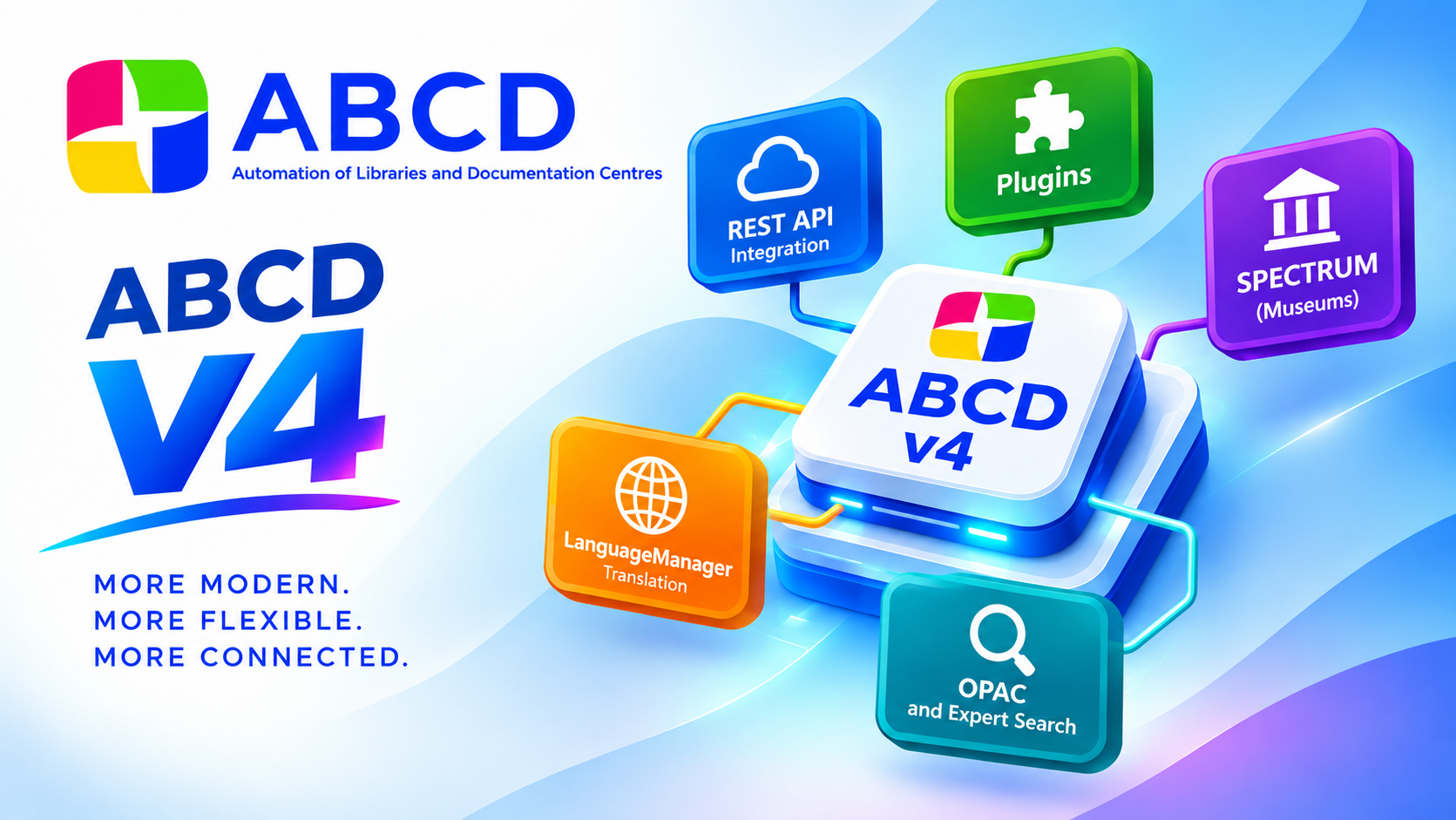
It is with great pride that ABCD Brasil announces the official release of ABCD version 4.0.0. This is not just another routine update, but an architectural milestone in the history of our software.
For many years, ABCD served the Information Science community as a robust ILS (Integrated Library System). With the arrival of version 4.0.0, the system takes a technological and conceptual leap, transforming into a true LSP (Library Services Platform). But what does this transition mean in practice for librarians, archivists, museologists, and memory institutions?
It means that ABCD is now more modular, expandable, and interoperable than ever before. The new version was redesigned to meet the complex demands of contemporary institutions, enabling advanced integrations and unprecedented customization.
Below, we detail the main innovations that make ABCD v4.0.0 our best version yet.
🧩 Modular Architecture and the Power of Plugins
The most profound change in the core of the system is the adoption of a plugin-based architecture. Instead of a monolithic software where all modules come pre-installed, ABCD now adopts an “on-demand installation” philosophy.
- Secure and Flexible Plugin System: Service expansion now occurs without the need to modify the central code (core) of the system. This ensures safer updates and a much more stable environment.
- A Lighter System: Legacy modules or those with very specific uses (such as the ODDS, SIP2, Projects, and Experts modules) have been removed from the default installation. Now, institutions remotely install only what they actually use, ensuring a more agile software focused on the real needs of each information unit.
🔗 Interoperability and Advanced Data Export
Integration with other ecosystems is the heart of an LSP. To ensure your data flows securely and smoothly, we have implemented new communication and extraction tools:
- Native REST API: ABCD now features a complete REST API that acts as a secure gateway for accessing CISIS databases. The API features centralized key management, SHA256 encryption, and strict control of read and write scopes, facilitating ABCD’s integration with other institutional systems.
- Batch JSON Export: Responding to a growing demand for more modern data formats, we introduced an integrated workflow for exporting databases in JSON. The system allows extraction in the native ISIS format or with direct mapping to the Dublin Core standard.
- Processing Resilience: The data conversion engine was completely restructured to process blocks of records individually. This ensures high tolerance against malformed XML markup, control characters, and UTF-8 encoding failures, preventing the export from freezing. The interface now includes a real-time progress bar and a secure manager for downloading and deleting the generated files.
🏛️ Museum Management of Excellence with the SPECTRUM Standard
Information Science serves an enormous diversity of collections. To address the specific needs of museums, version 4.0.0 introduces dedicated museology tools.
- New Data Model: We started the implementation of a database and management module aimed at museums, rigorously structured based on the international SPECTRUM standard. The structure of this database model results from the articulation between the parameters established in Spectrum and the practical experience consolidated in the Museum Cataloging Manual of the Centro Histórico e Cultural Mackenzie (CHCM), which collaborated in creating the model.
- OPAC Adapted for Museums: The public catalog (OPAC) gained new interfaces and display formats (PFTs) adapted specifically for museum collections, including the display of attachment metadata, artwork inscription control, and fully multilingual support.
🔍 The New OPAC: Expert Search and Performance
The end-user experience in the online catalog has always been a priority. In this version, the OPAC (which definitively replaced the old iAH) received substantial improvements both in interface and under-the-hood performance:
- Expert Search: We introduced a new direct boolean search interface. Results are now more cleanly organized in collapsible panels, allowing the user to easily switch between the search form and the results.
- Relevance Control and Performance: For institutions with large volumes of data, we added configurable controls for relevance ranking, increased the search buffer, and refactored the integrated search logic. The result is a much faster and more stable search.
- Metrics (Analytics): The search log analysis (OPAC Analytics) underwent performance optimizations, helping managers better understand their users’ search behavior quickly and efficiently.
🛠️ Administration, Security, and Enhanced Cataloging
Managing ABCD is now a safer, more organized, and intuitive task for information professionals:
- LanguageManager: We abandoned the old static language folders in favor of the new LanguageManager. This cascading translation system ensures that the core files remain separate from your institution’s local customizations (now saved in a secure folder called
content). This way, you can customize texts and menus without fear of losing them in future updates. - Reinforced Security (UI and System): The central topbar was completely redesigned. Additionally, we added a native interface for password changes with CSRF protection and applied rigorous sanitization of variables throughout the system to prevent vulnerabilities (XSS).
- Data Entry (Cataloging): To facilitate the creation of unique identifiers, we created the new
HASHfield type, which automatically generates secure cryptographic values. The handling of multi-select fields was also improved, as well as the integration of a secure assistant for generating auto-increment (AI) numbers. - Loan Synchronization: We created an automated routine that performs intelligent synchronization of the copies database with the loans database (loanobjects), saving librarians valuable time and avoiding rework.
ABCD v4.0.0 is the result of hard architectural work to deliver a free, robust tool aligned with the best practices of technology and modern librarianship.
We invite the entire community of librarians, archivists, and museologists to explore this new version. Full documentation and download files are already available in our official GitHub repository!
 ABCD Global